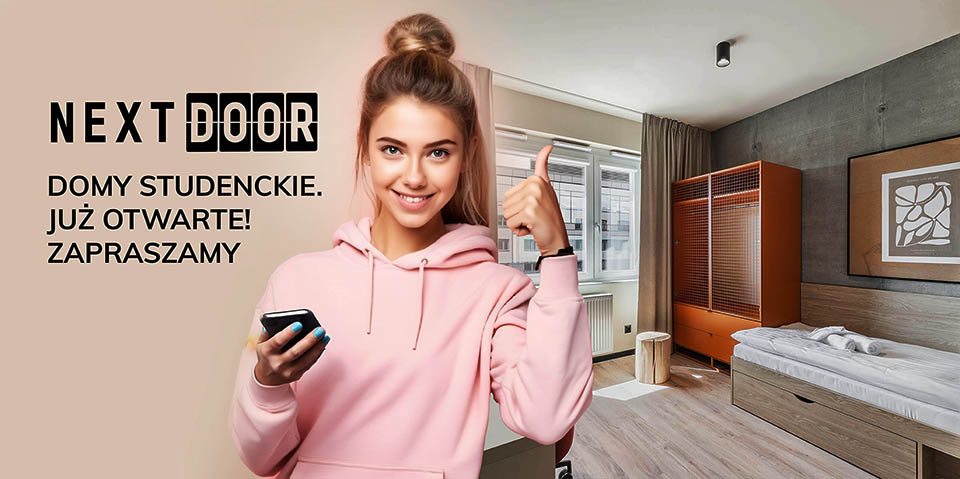



 NextDoor Housing
A private student residence is a purpose-built residential building offering en-suite rooms, common areas and hotel-like services, managed by a commercial entity or a non-public university, and is a key part of the PBSA (Purpose-Built Student Accommodation) sector. In September 2024, Base Camp in Wrocław, located in the revitalized former Mamut bakery, reached 100% occupancy already three months before the start of the academic year. Demand for this type of accommodation stems from the shortage of places in public university dormitories, which meet the needs of only 9% of the student population in Poland. At present, the private sector serves around 1% of students, but with a projected 1.4 million learners by 2030, these investments are becoming the foundation of educational infrastructure.
Price vs. value: PLN 1,370 for a room, but the price includes a gym, security and laundry
Accommodation costs in the PBSA segment are often viewed through the lens of a higher nominal rate, but a detailed economic analysis shows their strong cost efficiency compared with the dispersed rental market. The average rent in a private student residence in Poland was around PLN 1,370 per month (according to CBRE data from 2022), while renting a studio of a similar standard in Warsaw in 2024 means an expense of around PLN 3,000. The logic behind the choice is simple: the student chooses the residence, and the parent achieves savings of PLN 825 per month over the academic year, eliminating variable utility costs.
| Cost component | Private student residence (PBSA) | Private rental (studio) |
|---|---|---|
| Monthly rent | PLN 1370 – 2000 | PLN 2500 – 3500 |
| Utilities (electricity, water, Wi-Fi) | Included in the price | PLN 200 – 400 |
| Refundable deposit | 1 month’s rent | 2 months’ rent |
Renting an apartment from a private individual generates a number of financial risks and additional burdens that do not occur in professionally managed buildings. The commission for a real estate agency, usually equal to one month’s net rent plus 23% VAT, is a significant upfront cost for the household budget. Moreover, civil-law tenancy agreements often include indexation clauses based on the consumer price and services inflation index (HICP), which makes precise budgeting over a 12-month horizon impossible. Lack of control over utility bills and the absence of a flexible notice period adapted to the academic calendar are additional barriers for tenants.
Market experts emphasize that price pressure on the housing market is forcing the professionalization of accommodation services for young people. Jacek Leczkowski, vice president of the Erbud group, notes: “In Warsaw, studios in good standard go for PLN 3,000,” which positions PBSA as an attractive financial alternative. In buildings such as Student Depot or Base Camp, the fixed monthly fee covers not only the room, but also access to coworking areas, a gym, professional security and laundry facilities, which in the case of renting an apartment would require paying for additional commercial subscriptions.
Does the price include VAT for parents?
Yes, the rental price in a private student residence for people with student or pupil status is usually subject to 8% VAT (accommodation service). In the case of commercial rentals by business entities, the rate may be 23%.
24/7 security and access control – what a parent checks first
The safety of residents is a priority decision factor for legal guardians, especially in the context of the growing number of international students, which in the 2023/24 academic year reached 107,000 people (8.6% of the total). Modern PBSA buildings implement integrated technical security systems (TSS), which minimize the risk of unauthorized entry and ensure a rapid response in crisis situations. Parents verify safety standards by auditing the available technologies and the building manager’s operational procedures.
- Access control: The use of coded RFID proximity cards or digital keys in the technological standard of companies such as Salto or Assa Abloy.
- CCTV monitoring: Round-the-clock surveillance of corridors, common areas and building entrances in compliance with GDPR regulations.
- 24/7 reception: Staff trained in guest service and monitoring alarm systems around the clock.
- Contract with a qualified security company: Constant supervision and intervention patrols carried out by specialized providers, e.g. G4S or Securitas.
- CPR procedures and fire safety systems: Regular inspections of fire protection installations and availability of automated external defibrillators (AEDs).
The high standard of security is reflected in market statistics and the level of trust in this real estate sector. According to JLL reports, occupancy in private student residences in the largest urban centers in 2024 exceeded 95%, which demonstrates PBSA’s dominant position over traditional rentals in terms of perceived stability. Marek Obuchowicz from Griffin Capital Partners notes: “For parents, the safety of the buildings and the stability of costs are important,” which is difficult to guarantee in the dispersed rental market of privately owned apartments.
In 2023, the private stock offered only 12,500 beds compared with 69,600 in the public sector, yet it is the newly developed investments that are setting operational standards. Every modern building must have an up-to-date fire safety instruction and a fire alarm system (FAS) integrated with the monitoring of the State Fire Service. Professional property management eliminates risks associated with technical failures, which in private apartments often remain unresolved for a long time due to difficult contact with the owner.
Single room or twin? How a student chooses standard, and a parent looks at the kitchenette
The standard of finishing and the functionality of the living space are key aspects that distinguish PBSA from traditional dormitories. Modern residences offer a varied room structure, adapted to the needs of 89,000 international students and local residents who value privacy. The student spends time in a space that must be ergonomic, so the room must have a desk for work, a bed measuring at least 90×200 cm, a wardrobe 150 cm wide and an under-counter fridge with a capacity below 120 liters.
| Room type | Usable area | Average net rent |
|---|---|---|
| Single (one-person) | 16–20 m² | PLN 1450 |
| Twin (two-person) | 24–28 m² | PLN 950 / person |
| Studio Premium | 30+ m² | PLN 2100 |
An important differentiator is access to food preparation facilities, which directly affects quality of life and hygiene. In public dormitories, the standard remains one shared kitchen for 12–15 people, which often leads to conflicts and cleanliness issues. Private residences offer an optimized model: one kitchenette for 4–6 people in shared modules or integrated into each studio room. Jolanta Bubel from Student Depot emphasizes: “These investments prove how important high-standard accommodation is for young people in Poland,” combining privacy with functionality.
The choice between a single and a multi-person room depends on the budget and the student’s psychological profile. Single rooms guarantee full autonomy, which is crucial for people studying demanding subjects (e.g. medicine, law). Twin rooms, on the other hand, are preferred by first-year students for whom social integration and lower accommodation costs are priorities. Regardless of the chosen option, all PBSA-standard rooms have private bathrooms, which eliminates one of the biggest inconveniences of traditional dormitories.
Can you live with a partner?
Whether couples are allowed to live together depends on the rules of a given property. In most private student residences, renting a twin room or double studio for a couple is possible, provided that both people sign the agreement or a roommate is indicated in the application form.
PBSA location: 5 minutes on foot to university vs 25 minutes by tram from an apartment in Krowodrza
The location of the building relative to the university campus is a determinant affecting the student’s time and financial savings. For example, residents of Base Camp in Wrocław reach Wrocław University of Science and Technology in 4 minutes on foot, and residents of Student Depot in Kraków need only 6 minutes to get to the AGH University of Science and Technology. Unlike residences, renting an apartment in popular districts such as Kraków’s Krowodrza, Dębniki or Grzegórzki often requires using public transport, which extends commuting time to 25–40 minutes during peak hours.
The economic aspect of location is evident in the elimination of urban mobility costs. A student monthly ticket (e.g. the Kraków semester ticket or the Wrocław URBANCARD) costs around PLN 105, which over the academic year generates an expense exceeding PLN 900. Living in the immediate vicinity of the university reduces this cost to zero, while also offering:
- Maximization of time available for study and rest thanks to reduced commuting.
- Safer late-night returns from libraries or student events without needing night transport.
- Easy access to academic infrastructure (canteens, laboratories) between classes.
Urban analysis shows that private student residences are being built in city centers, often as a result of revitalizing post-industrial sites, which increases the attractiveness of the area. The demand for beds in student residences in Poland is estimated at 400,000, with a shortfall of around 60,000 beds in Warsaw alone. PBSA developments are designed to function as self-sufficient “micro-cities,” which, combined with proximity to major transport hubs, makes them the most desirable address for students prioritizing time efficiency.
Tenancy agreement: 10-month academic year, no 2x-rent deposit, quiet hours clause
The legal structure of agreements in the PBSA sector is precisely tailored to the higher education cycle, which distinguishes it from standard occasional rental agreements governed by the Civil Code. Operators such as Student Depot use contracts for a fixed 10-month period, corresponding to the actual length of the academic year (October–July). This solution protects the tenant from having to pay rent during the holiday months, unless the student decides to extend the stay for internships or seasonal work.
- Term: Standard 10 months with the option to extend for the summer.
- Security deposit: Usually equal to one month’s rent (0–1 month) instead of the market standard of 2–3 months’ rent.
- Notice period: Usually 1 month, effective at the end of the calendar month in special circumstances.
- Reservation fee: An amount of PLN 500–1000, credited towards the first rent payment or deposit.
- Subletting prohibition: An absolute ban on making the premises available to third parties without the manager’s consent.
- House rules appendix: Restrictive provisions regarding quiet hours from 10:00 p.m. to 6:00 a.m. under penalty of termination of the agreement.
Private student residences operate on the basis of Article 8 of the Consumer Rights Act, which ensures a high level of legal protection for tenants and transparency of settlements. A parent signing the agreement reduces the financial risk associated with losing a high deposit (often exceeding PLN 5,000 in the case of studios), because professional operators document the technical condition of the room using digital handover reports. Patrick Pospiech from JLL emphasizes that “PBSA offers competitive prices and better amenities,” which also includes clarity of contractual provisions free from legal traps typical of private rentals.
Unlike private landlords, PBSA operators cannot arbitrarily increase the rent during the term of the agreement, which guarantees budget stability throughout the study period. These agreements often also include clauses on joint liability in the case of multi-person rooms, but modern standards are moving toward individual contracts for each resident. Such a legal model increases the authority of the manager and builds trust in the student-parent-operator relationship, eliminating stress associated with housing uncertainty.