

 NextDoor Housing
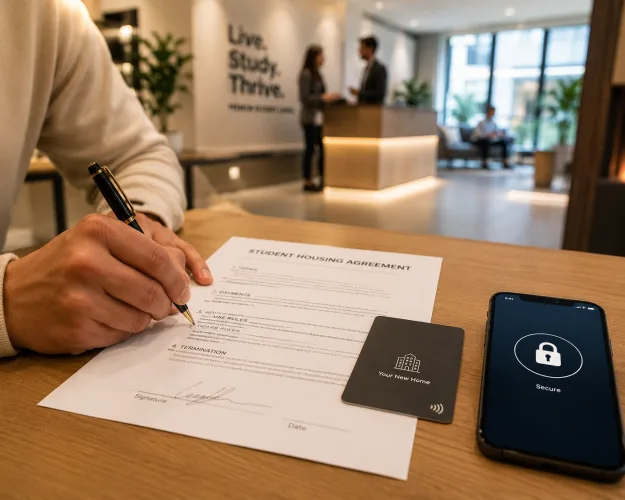
Entering the world of academic independence means facing procedures that are completely new to most young people. One of the most important, and at the same time most responsible, decisions at the beginning is securing your housing rights. Renting a room in a private premium student residence differs from the traditional, often chaotic rental of an apartment from private landlords on the open market. It offers a much higher level of stability, transparency, and legal security – provided you approach the matter methodically.
The real estate market in large academic cities can be ruthless, and a young person’s lack of experience can become a breeding ground for abuse by dishonest landlords. Signing a lease agreement or a housing services agreement is a legal act that creates specific financial and civil obligations.
This guide is a professional legal compendium that explains step by step the anatomy of a safe contract, exposes hidden legal traps, and teaches how to effectively protect your interests and money before, during, and after the reservation period ends.
1. What type of agreement are you signing? Lease agreement vs. accommodation agreement
The first step toward safe renting is understanding the legal nature of the document placed in front of you. In the case of institutional student accommodation (private student houses), you will most often encounter two models:
- Classic room lease agreement: Regulated by the Civil Code and the Act on the Protection of Tenants’ Rights. It gives you the premises (or a specified part of it) for use for a fixed period in exchange for rent. It provides very strong tenant protection, but it also comes with strict legal rules regarding termination.
- Accommodation services agreement: This is an unnamed contract combining elements of a lease with a services agreement (such as access to common areas, internet, cleaning, or security). It is the standard in premium facilities. It is characterized by greater flexibility and a precise definition of hotel-style and student-oriented standards, which is convenient for both parties, as long as all services are clearly described.
Regardless of which model your document represents, the key is transparency. All terms must be clear, understandable, and written in a language you fully understand (for international students, a bilingual Polish-English contract should be standard).
2. Anatomy of a safe contract: Absolutely required elements
A safe document cannot leave room for interpretation. Every aspect of your stay must be codified. Here are the elements that must be included in a properly drafted contract:
- Precise identification of the parties: Full details of the renting entity (company name, KRS, NIP, registered address) and your details (first name, surname, PESEL or passport number, correspondence address). If you are a foreign national, make sure your passport number is entered correctly.
- Accurate description of the subject of the agreement: The contract must clearly specify which room (or room type) you are reserving, its size, furnishings, and which common areas (kitchens, gaming zones, gym) you are entitled to use as part of the price.
- Duration of the agreement: In academic settings, fixed-term agreements are standard – usually for one academic year (5 or 10 months). The contract must contain the exact start date (the day the keys are handed over) and the end date of your stay.
- Fixed financial terms: A clearly specified monthly fee. The clause should state whether this amount already includes all utilities (electricity, water, heating, internet) or whether they are billed separately. In premium facilities, a single fixed flat fee is standard, protecting students from unexpected energy price increases in the middle of winter.
3. Finances under the microscope: Security deposit and hidden charges
The security deposit is the point of most disputes between tenant and landlord. The law clearly defines its purpose: it is meant to cover any damage caused by the tenant or outstanding payment arrears. It is not, however, extra profit for the property owner.
- Form and deadline for deposit return: The contract must include a strict clause specifying when, after the agreement ends, the deposit will be returned to your bank account. The Act on the Protection of Tenants’ Rights allows up to 30 days, but good practice in professional student residences shortens this period to 14 days after the room has been handed back without damage.
- Reservation fee: Often, before signing the actual contract, a reservation fee is paid to hold the room. Make sure the documents include a clause stating that, once the rental period begins, this fee is automatically credited toward the deposit or the first rent payment.
- Ban on unilateral price changes: The contract should guarantee that the price remains unchanged throughout its term. Avoid documents containing vague indexation clauses that would allow the rent to be increased during the semester without your consent.
4. Termination terms for a fixed-term contract
This is one of the biggest legal traps students fall into. Under Polish law (Article 673 § 3 of the Civil Code), a contract concluded for a fixed term cannot simply be terminated with ordinary notice unless the contract precisely defines specific grounds for such termination.
If you sign a 10-month contract and after three months decide to drop out of university or move elsewhere, and the contract does not provide for early termination, you are legally obliged to pay rent until the end of the contractual period, even if you no longer live there physically.
- Look for escape clauses: A well-drafted contract in a professional facility should provide for unforeseen circumstances. A safe document includes a clause allowing early termination, for example in the event of: being removed from the list of students, serious health problems, or – most commonly and practically – finding a replacement tenant for your place (the so-called assignment of the contract), who takes over your rights and obligations without financial loss to the facility operator.
5. Handover protocol: Your most important protective shield
Even the best contract will not protect you from losing your deposit if you neglect the formalities on key handover day. The handover protocol is a document of key procedural importance. It serves as proof of the technical condition of the room at the moment you moved in.
- Be excessively thorough: During check-in, do not rush. Walk through the room with the administrator and inspect every detail. Are the furniture surfaces scratched? Is the mattress clean and free of stains? Do the blinds work smoothly? Are there any paint chips on the walls? Is the appliances functioning properly?
- Record every defect: Every flaw, even the smallest scratch, cracked plastic in a drawer, or stain on the carpet, must be noted in the protocol in writing. If the administrator says, “Oh, we know about that, don’t worry, we won’t make a problem out of it when you move out” – do not take their word for it. Ask for it to be written into the document. Words disappear; signed paper remains.
- Photo documentation: Take detailed photos of all room defects on the day you move in. Ideally, the photos should have the date and time embedded in the file (EXIF data). Send those photos by email to the facility administration within the first 24 hours after moving in. This is irrefutable evidence that will end any discussion about possible deductions from the deposit when you move out.
6. Rights and obligations during your stay, or the house rules
When signing a contract in a private student residence, the Student Residence Regulations usually become an integral part of the documentation. They have the same legal force as the contract itself. Read them carefully before signing, because they govern your everyday life:
- Guest policy: Check under what conditions friends or family may visit you. Can they stay overnight in your room, and if so, for how many days per month and whether this involves an extra fee or the need to notify reception?
- Breakdowns and repairs: Who is responsible for faults? In professional residences, repairs resulting from normal wear and tear of equipment (e.g. a blown light bulb, a broken fridge, a clogged drain) are carried out free of charge and quickly by the in-house technical team. However, if damage is caused by your clear fault (e.g. a broken window), you will be charged for it.
- Right to privacy: Remember that the landlord has the right to inspect the technical condition of the room, but cannot do so in a harassing manner. The regulations should clearly state that routine technical inspections (e.g. ventilation or fire safety systems) take place after residents have been notified in advance. Entry by staff in your absence should be limited exclusively to emergency situations (e.g. flooding from the room below).
Summary: Golden rules for safe renting
Renting a room in a private student residence is an excellent step toward independence, offering safe, predictable, and civilized living conditions that are hard to find on the wild market of private lodgings. To make the process 100% safe, always follow these three iron rules:
- Never sign a document under time pressure – you have every right to ask for a copy of the contract by email a few days in advance so you can read it calmly at home and consult it with your parents or a lawyer.
- Put everything in writing – any arrangements, approvals for room modifications, or repair reports must be made in written or electronic form (email).
- Respect the space, but enforce your rights – you are a full party to the contract, paying for a specific standard and entitled to expect the operator to fully comply with it.
With this approach, you will gain complete peace of mind, and legal formalities will become a simple, stress-free procedure that opens the door to a safe and exciting student life.