

 NextDoor Housing
Daily meals in a dorm are more than just quick snacks – they are a daily logistical puzzle where time, money, and access to equipment matter. The main barriers in the process of collective meal preparation in student housing are the drastic lack of workspace, a limited operating budget, and a shared kitchen where user turnover ranges from 8 to 12 people per station. Effective organization requires implementing meal-prep techniques and precise micro-scale resource management. The article below presents ready-made technical and cost-effective solutions for students at Tricity universities such as the Gdańsk University of Technology and the University of Gdańsk.
Dorm Kitchen: What You Have, What You Don’t Have, and How to Work Around It
An inventory of the technical realities in student housing shows significant deficiencies in ergonomics and workstation equipment. A standard kitchen unit in facilities such as DS PG or DS UG offers workspace where the countertop is usually shorter than a 15-inch laptop, which makes it impossible to spread out cooking accessories comfortably. Limitations also result from fire safety regulations, which in DS PG cap the maximum power of an electric kettle at 1000 W, directly affecting the thermal processing time of food.
Typical equipment in a shared student kitchen consists of only a few items that must serve a dozen or so residents at the same time. A lack of continuity in cleaning and the limited capacity of refrigeration units force residents to use mobile and compact solutions. The list below presents the actual equipment situation a student has to deal with in everyday cooking practice:
- 20 L microwave – the basic heating appliance in every shared kitchen
- 0.8 L kettle – with a heating power limited to a maximum of 1000 W
- 24 cm frying pan – the only pan with a working diameter smaller than the hotplate
- Refrigerator – the usable space per resident is equivalent to the size of an A4 shelf
The lack of full-size kitchen equipment does not have to be an insurmountable barrier to preparing a nutritious meal. By using appropriate substitute techniques, you can prepare dishes with a high nutrient density using only basic tableware or simple household appliances. The table below presents methods for working around equipment shortages while maintaining nutritional standards:
| Missing item | Dish | Method |
|---|---|---|
| Chef’s knife | Tuna wrap | Can opener + fork |
| Pot | Microwave egg | Mug + water + 3 min at 600 W |
Using equipment substitutes helps reduce costs and eliminate logistical problems related to storing your own dishes. Cut ingredients with the edge of a metal fork or use a kettle to quickly prepare couscous. Meal preparation requires only the minimum necessary space, and a good practice is to invest in a folding colander, which takes up as much space as a flat plate while making it easier to drain loose products.
5-Day Plan in 30 Minutes: Cook Once, Eat All Week
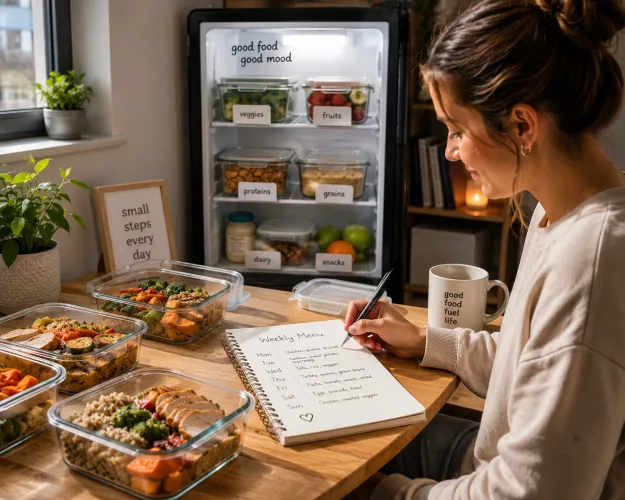
Meal planning in a dorm is based on the meal-prep strategy, meaning the one-time preparation of a base of ingredients for a longer period of food use. The goal of this process is to maximize time efficiency and save electricity by batch-cooking products such as rice, chickpeas, and carrots. According to food safety rules, ready components should be stored in the refrigerator for up to 4 days, while avoiding glass containers for health and safety reasons applicable in most dorms.
The shopping basket optimized to a budget of 35 PLN is based on products with a high satiety index and a long shelf life. The list below forms the foundation of a 5-day meal cycle, taking into account current market prices (as of February 2025) and the preferred net weight of products. Thanks to the precise selection of protein, carbohydrates, and vegetables, the student receives a complete matrix of nutrients at a cost not exceeding 7 PLN per daily lunch portion.
- Jasmine buckwheat groats 500 g – 4.50 PLN
- Basmati rice 500 g – 3.99 PLN
- Wholegrain pasta 400 g – 5.00 PLN
- Can of chickpeas 400 g – 3.00 PLN
- Chicken breast fillet 400 g – 10.00 PLN
- Low-fat quark 250 g – 4.00 PLN
- Carrots 1 kg – 2.50 PLN
- Yellow onions 0.5 kg – 1.00 PLN
- Frozen green beans 450 g – 4.00 PLN
A 30-minute cooking block makes it possible to prepare all the basic ingredients without spending hours in the shared kitchen. The key to success is sequential action and making use of the hygroscopic properties of dry ingredients. Keep in mind that basmati rice (12-minute cooking time) and buckwheat groats (15-minute cooking time) can be prepared in one vessel in layers, which saves space on the only available hotplate.
- Boil water in the kettle to speed up the process in the pot.
- Add the rice and groats to the pot, keeping the water ratio at 2:1.
- Chop the vegetables and meat into small cubes with 1.5 cm sides while the carbohydrate base is cooking.
- Pan-fry the chicken with the chickpeas in a 24 cm frying pan for about 8–10 minutes.
- Remove the dishes from the heat once the products reach the desired softness.
- Transfer the finished components into plastic containers once their temperature drops below 60 °C.
Closing the containers after they have cooled slightly helps avoid condensation, which significantly extends the shelf life of meals. Meal-prep in a dorm is not only a time optimization method, but also an environmentally conscious practice that reduces food waste through precise portion planning. Quick lunches prepared this way are ready to eat after just 2 minutes of reheating in a 20 L microwave.
Dorm Island Price List: How Much Does a Full Day of Eating Cost
An analysis of food expenses in the student environment in the Tricity shows drastic differences in operating costs depending on the chosen consumption model. The most economically efficient option is your own meal-prep, based on products bought in discount stores such as Tesco Gdańsk Wrzeszcz (prices from February 2025). A comparison of three options: self-cooking, the dorm canteen (e.g. DS UG), and a hybrid model (mix), highlights potential financial surpluses that can be used for other development-related expenses.
The comparative data includes gross prices and the average energy needs of an adult student. The University of Gdańsk canteen offers a student lunch for 8.00 PLN thanks to ministerial subsidies, making it an attractive alternative, though still more expensive than processing raw ingredients in your room or shared kitchen. The table below organizes daily food spending depending on your meal-planning discipline:
| Variant | Breakfast | Lunch | Dinner | Day |
|---|---|---|---|---|
| Meal-prep | 2.30 PLN | 4.10 PLN | 3.20 PLN | 9.60 PLN |
| UG canteen | 4.50 PLN | 8.00 PLN | 6.00 PLN | 18.50 PLN |
| Mix | 2.30 PLN | 12.00 PLN | 3.20 PLN | 17.50 PLN |
A daily difference of 8.90 PLN adds up to 267 PLN per month – that is how much a gym membership costs.
Tracking expenses by keeping receipts and regularly checking refrigerator stock helps avoid unplanned costs, which according to statistics can reach as much as 400 PLN per month without a shopping list. Buy groats by weight, which is 20% cheaper than products packed in individual bags. Careful budgeting based on local prices from Gdańsk Wrzeszcz makes it possible to maintain a high-quality diet while keeping spending to a minimum.
FAQ – the Most Common Excuses and a Straight Answer
What should I do if my food gets stolen?
What should I do when I have no time?
What should I do when there is no room in the fridge?
What should I do when the queue for the kitchen is too long?
What should I do when I run out of ideas for cheap meals?