

 NextDoor Housing
The relaxation zone in a dormitory is a dedicated space designed in line with the emotional-zoning concept, whose purpose is to reduce stress, restore attention, and support the student’s mental health. In the 2024/2025 school year, the number of pupils and students on the autism spectrum in Polish educational institutions reached nearly 126.4 thousand, which clearly indicates the growing demand for quiet refuges that support sensory integration. Implementing such solutions brings measurable administrative benefits; for example, in Mikołów, 10 schools introduced professional acoustic booths, resulting in a reported 30% drop in peer conflicts.
80 dB of noise in the corridor kills concentration – why silence is the first remedy
Noise levels in the circulation areas of educational institutions and dormitories during breaks regularly reach 80–85 dB. This is comparable to the noise generated by a busy city artery or a running vacuum cleaner, which drastically exceeds the physiological norms for mental work. Research conducted by scientists from Spain shows that children and young people aged 6–12 exposed to noise above 60 dB demonstrate a 25% average decrease in working memory performance and concentration ability. In an academic environment, where learning processes are intensive, chronic exposure to such stimuli leads to rapid depletion of cognitive resources.
| Place | Average sound level | Effect |
|---|---|---|
| Corridor during break | 80–85 dB | Stress, reduced concentration |
| Classroom during lessons | 53–77 dB | Difficulty understanding speech |
| Quiet zone (after insulation) | 35–40 dB | Optimum for the brain |
The Central Institute for Labour Protection – National Research Institute (CIOP-PIB) clearly identifies noise as the main nuisance factor in school and academic environments. The average background noise penetrating lecture halls ranges from 40 to 50 dB, making it impossible to maintain the recommended 35–40 dB threshold necessary for uninterrupted speech perception and full decoding of educational messages. A lack of proper acoustic insulation forces the student’s body to continually fight distractions, resulting in permanent fatigue and lower academic performance.
Applying the principles of emotional-zoning makes it possible to interrupt the negative physiological chain in which excessive noise stimulates cortisol secretion, leading to the degradation of memory traces. Introducing a controlled quiet zone initiates regenerative processes through activation of the parasympathetic system and stimulation of oxytocin and dopamine release. Regeneration of brain structures responsible for executive functions is most effective in an environment where sound does not exceed 40 dB, making dedicated quiet zones an essential part of infrastructure supporting student well-being.
To acoustically optimise the quiet zone, it is recommended to invest in materials with a high sound absorption coefficient, such as thick commercial carpeting and heavy velvet curtains, which can reduce noise by about 10 dB at a relatively low cost. Strategic placement of the zone is also crucial; it should be located at least 5 metres from the main corridor and away from sources of building noise, such as lift shafts or shared kitchens. Precisely separating the relaxation area from circulation spaces builds a sense of safety for overstimulated individuals, including students with certificates confirming the need for special education.
Board game zone – how 45 minutes at the table increases productivity by 20%
Board games are an advanced neuropsychological stimulation tool, engaging seven key cognitive processes: data analysis, information synthesis, negotiation, counting, working memory, reading comprehension, and entrepreneurship. As Aleksandra Kubala-Kulpińska points out in the 2020 publication of “Głos Pedagogiczny,” this activity is optimal in the age of digital dominance because it requires direct social interaction and trains assertiveness. In an academic context, the games zone serves as an incubator for soft skills, which are essential for students’ future professional careers.
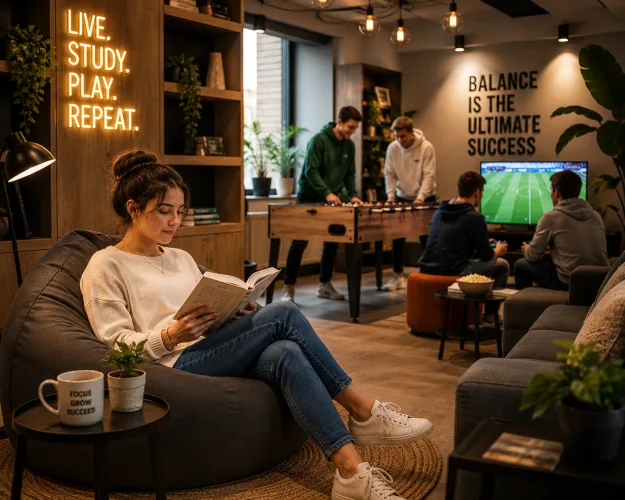
The practical use of a games zone in everyday dormitory life can be observed during evening integration sessions. A typical game of a title such as “Ticket to Ride,” lasting usually 45 minutes, can reduce stress levels measured on a subjective feelings scale from 7 to 4. The networking effect, meaning the formation of lasting relationships between students from different years of study, is a direct result of working toward shared goals in the game. Such activity strengthens the dormitory’s social structure and builds a trust-based community among residents.
- 1 game = 45 min of high-quality interpersonal contact without exposure to blue light from screens.
- 20% increase in overall well-being declared by students in survey research after 4 weeks of regular use of the zone (sample n=120).
- PLN 3,000 – total cost of furnishing a library corner with 30 diverse titles, which is less than the purchase price of one professional acoustic armchair (PLN 4,000).
Building a basic game collection should be based on titles that fulfil specific developmental functions. “Carcassonne” perfectly supports learning spatial planning and managing limited resources, “Dixit” stimulates linguistic creativity and abstract thinking, while “Kodnemy” (Codenames) emphasises logical linking of facts and precise group communication. Choosing these titles ensures that time spent in the relaxation zone will be not only a form of rest, but also unconscious intellectual training.
Organising such a space does not require a large footprint; it is enough to designate 12 m² of usable area equipped with a table measuring at least 120×80 cm. Funding for the project can be based on grants from the Student Council, for which applications are usually submitted electronically (using the Trusted Profile or a qualified signature) by 15 March each calendar year. This is an investment with a very high return in the area of student community mental health.
Relaxation zone – from idea to a finished corner in 7 days. Cost: PLN 0.9 thousand
The process of adapting a space for a relaxation zone is based on the logic of identifying niches with low background noise, which makes it possible to minimise acoustic adaptation costs. The best parameters are offered by spaces under staircases, less frequently used corridors ending in a blank wall, or designated sleeping areas. Excluding high-traffic zones such as main building entrances or the immediate vicinity of lifts is crucial to preserving the functionality of the restorative refuge in line with the emotional-zoning principle.
Choosing colours and finishing materials has a direct impact on users’ physiological parameters. Using the shade blue with hex code #7BA7D1 lowers resting heart rate by an average of 6 beats per minute, as confirmed by ILS research in 2022. To warm up the interior and improve the microclimate, it is worth combining this shade with natural matte ash wood and a wool rug measuring 160×230 cm. This material configuration not only soothes the eye but also effectively absorbs sound waves, reducing reverberation in the room.
- Wall: latex paint, shade “Sea Salt,” 12 m² × PLN 18 = PLN 216.
- Rug: wool, 160×230 cm, price PLN 699 (available from Moderno Meble).
- Armchair: Lambi U-shaped model priced at PLN 2,899 – includes an integrated blanket storage compartment and a high acoustic backrest providing side insulation.
Funding the dormitory relaxation zone project can be achieved through three independent sources. The first is the Student Council budget, requiring an application to be submitted by 15 March. The second option is a targeted grant from the University Council, which for health-promoting projects can amount to up to PLN 5,000. An alternative to institutional funds is crowdfunding among dormitory residents – a community fundraiser in which donors who contribute small amounts (e.g. PLN 10) receive symbolic rewards, further strengthening the sense of co-ownership of the newly created space.
The project can be completed within a 7-business-day cycle. The schedule предусматривает 2 days for painting and substrate preparation, 3 days for delivery of ordered furniture (e.g. corner sofas from the Lambi series available in various fabric options such as boucle or chenille), and 2 days for installing accessories and lighting. It is worth installing a dimmable LED lamp with a colour temperature of 2700 K (cost around PLN 89), which makes it possible to create a “twilight” effect conducive to calming the body before sleep.
FAQ – 5 most common dean’s office excuses and ready-made answers
Will the dormitory budget have funds for such an investment?
The cost of purchasing one professional acoustic booth is about PLN 4,000, which is only 0.3% of the annual renovation budget of an average dormitory with capital of PLN 1.2 million. In addition, funds can be obtained from ministerial programmes such as “Mental Health” or from University Council grants dedicated to improving students’ living conditions.
Won’t the relaxation zone take up space for extra beds for students?
A standard 12 m² zone occupies only 0.15% of the total usable area of an 8,000 m² dormitory. This investment pays off by reducing resident turnover; the cost of supporting one student is about PLN 650 per month, and after 6 months from the opening of the zone, this cost realistically drops by PLN 40 per person thanks to fewer psychological interventions and withdrawals from accommodation.
How can alcohol consumption and disorder in the chillout zone be prevented?
An effective solution is to introduce a strict set of rules: mandatory silence from 10:00 p.m. to 6:00 a.m., an absolute ban on bringing alcohol in, and an online booking system. Data from pilot implementations in Mikołów show that after 3 months of operation, the number of order-related incidents in such places is zero, which results from the strong self-control of a group that values access to the refuge.
Who will be responsible for keeping the zone clean and maintaining its equipment?
Choosing appropriate materials, such as washable fabrics in Lambi corner sofas (cleaning with water and microfiber takes 5 minutes), minimises maintenance costs. The cultural section of the Residents’ Council is usually responsible for overseeing board games and equipment, which additionally encourages students to take responsibility for shared property.
Won’t the games zone generate additional noise for residents of neighbouring rooms?
Using acoustic insulation in the form of wall panels, rugs, and upholstered furniture effectively dampens high-frequency sounds (laughter, conversation). Locating the zone in niches at least 5 metres away from room doors and using acoustic booths completely eliminates the problem of noise leaking into the night-time area.